SKYFARER by Joseph Brassey (as an aside, Angry Robot may be one of my new favorite publishers) -- I did a video review if you want to listen to me instead of reading, though this is write-up is meant to complement that video. With that out of the way...
What book would you run away with and read forever, if it asked you? Have you ever read a book that made you excited about it even after you were finished? Joseph Brassey's Skyfarer is that book for me. If Skyfarer asked me to run away with it, marry it, and never read another book except for it for all eternity... I might very well say yes. The unfortunate part of that would mean I wouldn't get to read the rest of the Drifting Lands series; I don't think I could give up that chance, if the promise of Skyfarer carries through--and I full-well believe it will.
Talking about this book has functioned as a way to talk about and reflect on my own reading life--something that not all books do. It may not serve this function for all readers, but it is difficult for me to untangle the two. Reading Skyfarer was a strong reading experience.
Think about it--I was so enthused about Skyfarer that I sat down and did a video review of the book. I'm not good on camera, I didn't script or outline anything--this means it's a little rambly, it's a little all over, and more than a few thoughts got jumbled or left hanging. I also hate seeing my own reflection, so that was a big deal. This book is a big deal to me. To the point that I worry if I'm being too enthusiastic, too creepy about my love for it. But, I am who I am, right? In any case, this written review is meant to do two things--answer some of my hanging statements and elaborate on places where I wandered down a rabbit hole.
On Mr. Brassey's Work: Skyfarer is his second solo novel and his first set in a world of his own making. I ramble a little bit about the impression I had about it being his debut. And in many ways, it actually is. My impression wasn't far off, but I don't want to misinform anyone.
I lost my train of thought when talking about a cover quote regarding how Skyfarer is set apart from Firefly and the Battle of Helm's Deep; it's unfortunate, but when thinking about connections, it is easy for me to get lost. What I wanted to express in that place was the way Mark Teppo's quote sets Skyfarer into that constellation of speculative fiction giants. Skyfarer isn't Firefly and Brassey isn't Tolkien, but for a reader familiar with both those works, the connections ring true. By setting Skyfarer apart, Teppo's comment creates a tension of comparison and contrast that Skyfarer earns with its character development (which includes spaces, as in the way Serenity is a character in Firefly), the scope of its fight scenes (both small and large), and the world-building that plays out in small spaces of text but express so much.
But these connections are not the only connections this book evoked for me as a reader. The first novel I owned, the first fantasy novel I remember reading that was so distinctly fantasy--probably remembered so strongly because it was physically my first novel I didn't borrow from someone else or check out at the library--was Dragons of Autumn Twilight, the first novel in the Dragonlance series. I used books to escape, which should come as no surprise to anyone who knows my history. It was fun to read and engaging in a way that was shiny and new. It left its mark. And so, too, does Skyfarer.
Skyfarer resurrected that original joy in reading for me. It was fun.
As I say in my video review, there is no higher praise that I can give Skyfarer than to say that it evoked deep, forgotten feelings in regard to the experience of reading, and all that entails.
The roots of why I read are deep, and Skyfarer reached them all.
"There's something pristine about this novel." In trying to express how the story came across, the words "pristine, genuine, earnest" all rose up. I still feel that is true. There's something fresh and unsullied about the way Skyfarer is written--but still not a 'first novel'. We forgive a lot in first novels, often. I'll skip naming names--we all know a series of novels where the first books were not up to par with what we expect in the fifth+ novel of a series. If the rest of the Drifting Lands books maintain the standard Skyfarer sets, though? I'd still be happy. I suspect, however, that they will raise the bar more. My inner-reader gets giddy at the notion.
That said, we come to the matter of critique and the things we can say against a fantasy novel, and a topic I touched on and then moved away from pretty quickly in my video review; cliches.
It would be easy to pick at the cliches or telegraphed events in Skyfarer--they happen. They are there. Maybe you only think they are cliches if they are used badly--in which case, there are no cliches in Skyfarer. If you have a chip on your shoulder about prophecies or chosen ones, Skyfarer may not be for you--though I'd argue passionately that you should give it a chance to see it done beautifully. If Brassey were a different kind of artist, if Skyfarer were a sculpture, you would see the familiar forms of the masters, lovingly rendered and put together to create something both new and familiar. Like I say in my review, when you are eating beef stew, you expect there to be beef. When you're reading fantasy, you should expect there to be markers of the genre.
Where Brassey elevates those things is what sets him apart. Perhaps my favorite is one of the main characters, Aimee. She is an apprentice. She is coming onto a ship as a crew member for the first time, entering into the skyfaring life right out of an academy. She is a novice but she's not naive. It seems like a small distinction, but it plays out so strongly in her personality in ways that matter, that set her apart. These things take her away from the cliche of the archetypal "Fool" in ways that impact the story and the experience of reading it. Ways that make her a character I deeply enjoy.
"[She] navigates this space between being new, being untested ... and someone who is savvy about what they do. ... and has confidence and skills that they have coming out of whatever program or experience they've had. I have found that's difficult to find in a book, to find a character who is already so developed when you meet them on the page."
In short--because I could talk about this book for more words than are in the book--Brassey demonstrates skill, as far as I'm concerned, in his craft that I found refreshing and fun. The structure of the story I could see roughly outlined right away, but it didn't make the experience less enjoyable. The characters were surprising in that they did not need to develop with the story (though they do develop and change as the story goes along), but in showing up as whole people right away, even the "newbie" that Aimee represents.
If you have ever loved a fantasy novel and you have missed that feeling of joy because you've been saturated with so much of it, I encourage you to pick up Skyfarer.
Showing posts with label reviews. Show all posts
Friday, November 24, 2017
Thursday, June 29, 2017
Reviewish: Ubo by Steve Rasnic Tem
I really meant to get down to reviewing Ubo months ago. Unfortunately, I'm me. Much delayed, but still deserving of my time and thought.
Right away, I will note that it was described to me originally as Science-Fiction Horror; while it is that, it's also not horror in the way that pop culture often doles out the label. This is much more cerebral in some of its horrific aspects while still maintaining the visceral, disturbing facets we love so much in horror.
By nesting stories within the story, Steve Rasnic Tem has created an unsettling meditation on and look at humanity in its most inhumane moments, without being gratuitous. It is unflinching, unapologetic, and still somehow touching.
About halfway through, I really thought I knew where it was going, what was going to be the reveal--no, i was wrong. I would have been happy to be right, but I was happier with what Tem did in many ways.
My only criticism is that there was an incomplete sense to the world-building outside the space in which the primary action of the novel takes place. Not in the sense that Tem didn't DO the world-building, but that the reader doesn't get the bigger, broader picture. Which isn't necessarily a negative, however; to the contrary, it creates a desire for MORE of the setting and world in which Ubo exists. There are a lot of questions left unanswered, but if you're willing to hold on and go on the ride, it's definitely satisfying.
The story telling is thoughtful and direct, with a solid voice behind it. While I felt some trepidation (both for the storytelling and the story) in the beginning, I'm extremely glad I picked this book out to read!
4/5 stars
Transparency: I received this book through the publisher via NetGalley. I do not receive any affiliate bonuses from links to books (or other products) on this blog.
Wednesday, March 29, 2017
Reviewish: A Taste of Honey
It was difficult to rate this book, given my usual standards that rely so much on the narrative voice and on how I might recommend a book to another reader -- which is why I'm thankful for a blog where I can discuss these things a bit more fully.
In both of those categories (narrative voice and recommending the book to others), A TASTE OF HONEY, by Kai Ashante Wilson, has some issues which I'll explain in a moment. In other ways, though, it shines. If I dismissed the first two, I would give it 4 stars, but I can't, and so 3 stars it is.
First, I'll talk about my issues with the text:
I had to keep making a lot of excuses for the story in order to maintain my suspension of disbelief.
Part of what I consider a good narrative voice's job is to make it easier for the reader to immerse and stay immersed in the world unfolding before them. This story has two things working against it in that regard; a nonlinear telling of the story (less of an issue, more my personal preference - so I don't really hold this against the book) and sudden shifts in jargon and slang. The narrator, a close third-person following Aqib, is the reader's primary source for language usage and it is a very poetic voice. It is interior to Aqib and sets the tone of the character overall. However, when it comes to dialogue, there were a few jarring shifts, particularly when it came to the Dalucan soldier, Lucrio. What makes it jarring is that Lucrio is speaking in Aqib's language, which sets up the expectation for what modes of expression are available to a speaker based on the narrator's voice. But Lucrio is so variable as to be distracting; he falls into diction and slang choices that are baffling.
Here's the first place I had to "make excuses" for
the narrative choices, in order to stay in the story. Aqib's experience of the language is from an upper social tier, leaving little room for expressions like "somebody's gotta learn 'em" and "looky there" and several other instances of a dialect shift akin to representations of Southern American English. But Lucrio is a foreigner, so I am able to consider that the dialect shift comes in from having learned the language from someone more on the level of a soldier or "menial" (the narrator's word, not mine). But as the narrative progresses, Lucrio's word choices come to match Aqib's more closely, with the occasional shift back to apparent slang, and some rather anachronistic-feeling swears. There's no explanation for these words or expressions and outside of a foreigner speaking the language native to the narrative, there's no framework for me - as the reader - to explain where they come from. The overall effect is jarring, at best.
Shorter version of this issue: Lucrio's sudden Southern American English dialogue is jarring in the context of the voice the narrator establishes for the story, ESPECIALLY because he is speaking Aqib's language and somehow has a full grasp of slang that we, as readers, have no foundation for accepting as part of the world-building aspect at this point. Nor do we see any other characters engaging in slang or modern Earth equivalent swearing. (There are two exceptions, neither provided with any context/explanation either, and given in isolation.)
The other matter is the overall disjointed feeling that there's some world-building missing. I found myself FREQUENTLY making the excuse, in a book club discussion, that this was a novella; it's shorter and there's a full length novel set in the same world, and SURELY these things that we experienced questions or gaps about were explained more fully and in more detail there. This became a mantra while reading. It is worth noting, however, that many reviews (even positive ones) describe this same feeling about the novel (Sorcerer of the Wildeeps).
That said, I still enjoyed this story and would recommend it for folks looking for second world/alternate Earth (I'm not sure which is the more accurate description because of the above mentioned gaps) that moves away from the northern European flavors so prominent in fantasy. The main character is gay and that is a key facet of the story without it being what the story is about. The intersections of identity that happen in the context of so small a story are complex and beautiful. There's love in its myriad forms; the struggle to navigate the ebbs and flows as they push and pull against each other feels like the heart of the story. There's joy and regret. Trust, betrayal, suspicion... a lot packed into such a small space.
The ending left me feeling a little cheated, initially, but also opened up the opportunity to more closely consider the whole text in a different way and left me curious about the world. It was a satisfying ending in many ways--an aspect so many texts fall short of achieving. Knowing what I know with the end's reveal, it certainly asks for a re-read.
I know that I will spend at least as much time thinking about and going back through the story as I spent on reading it the first time--and in my reading habits, that is one of the highest praises I can offer.
In both of those categories (narrative voice and recommending the book to others), A TASTE OF HONEY, by Kai Ashante Wilson, has some issues which I'll explain in a moment. In other ways, though, it shines. If I dismissed the first two, I would give it 4 stars, but I can't, and so 3 stars it is.I had to keep making a lot of excuses for the story in order to maintain my suspension of disbelief.
Part of what I consider a good narrative voice's job is to make it easier for the reader to immerse and stay immersed in the world unfolding before them. This story has two things working against it in that regard; a nonlinear telling of the story (less of an issue, more my personal preference - so I don't really hold this against the book) and sudden shifts in jargon and slang. The narrator, a close third-person following Aqib, is the reader's primary source for language usage and it is a very poetic voice. It is interior to Aqib and sets the tone of the character overall. However, when it comes to dialogue, there were a few jarring shifts, particularly when it came to the Dalucan soldier, Lucrio. What makes it jarring is that Lucrio is speaking in Aqib's language, which sets up the expectation for what modes of expression are available to a speaker based on the narrator's voice. But Lucrio is so variable as to be distracting; he falls into diction and slang choices that are baffling.
Here's the first place I had to "make excuses" for
the narrative choices, in order to stay in the story. Aqib's experience of the language is from an upper social tier, leaving little room for expressions like "somebody's gotta learn 'em" and "looky there" and several other instances of a dialect shift akin to representations of Southern American English. But Lucrio is a foreigner, so I am able to consider that the dialect shift comes in from having learned the language from someone more on the level of a soldier or "menial" (the narrator's word, not mine). But as the narrative progresses, Lucrio's word choices come to match Aqib's more closely, with the occasional shift back to apparent slang, and some rather anachronistic-feeling swears. There's no explanation for these words or expressions and outside of a foreigner speaking the language native to the narrative, there's no framework for me - as the reader - to explain where they come from. The overall effect is jarring, at best.
Shorter version of this issue: Lucrio's sudden Southern American English dialogue is jarring in the context of the voice the narrator establishes for the story, ESPECIALLY because he is speaking Aqib's language and somehow has a full grasp of slang that we, as readers, have no foundation for accepting as part of the world-building aspect at this point. Nor do we see any other characters engaging in slang or modern Earth equivalent swearing. (There are two exceptions, neither provided with any context/explanation either, and given in isolation.)
The other matter is the overall disjointed feeling that there's some world-building missing. I found myself FREQUENTLY making the excuse, in a book club discussion, that this was a novella; it's shorter and there's a full length novel set in the same world, and SURELY these things that we experienced questions or gaps about were explained more fully and in more detail there. This became a mantra while reading. It is worth noting, however, that many reviews (even positive ones) describe this same feeling about the novel (Sorcerer of the Wildeeps).
That said, I still enjoyed this story and would recommend it for folks looking for second world/alternate Earth (I'm not sure which is the more accurate description because of the above mentioned gaps) that moves away from the northern European flavors so prominent in fantasy. The main character is gay and that is a key facet of the story without it being what the story is about. The intersections of identity that happen in the context of so small a story are complex and beautiful. There's love in its myriad forms; the struggle to navigate the ebbs and flows as they push and pull against each other feels like the heart of the story. There's joy and regret. Trust, betrayal, suspicion... a lot packed into such a small space.
The ending left me feeling a little cheated, initially, but also opened up the opportunity to more closely consider the whole text in a different way and left me curious about the world. It was a satisfying ending in many ways--an aspect so many texts fall short of achieving. Knowing what I know with the end's reveal, it certainly asks for a re-read.
I know that I will spend at least as much time thinking about and going back through the story as I spent on reading it the first time--and in my reading habits, that is one of the highest praises I can offer.
Tuesday, October 25, 2016
Reviewish: Certain Dark Things
I am extremely excited to talk about Silvia Moreno-Garcia's second novel, Certain Dark Things, which released today (October 25th). Ultimately, I'm giving this one five stars; I loved it. But, I want to talk about it, so you can decide that you want to take a chance on loving it too.
Let me start with a history lesson; in Moreno-Garcia's collection of short stories, Love & Other Poisons, there is a story called "A Puddle of Blood" - it's available to read online (just click on the title), if you're interested. In fact, it might help convince you that this novel is worth a few hours of your time. Adding a little more prestige to its mantle, this short story is also found in Evolve 2: Vampire Stories of the Future Undead and Imaginarium 2012: The Best Canadian Speculative Writing. But I strongly suggest picking up Moreno-Garcia's collection directly - it is a trove of great storytelling. Of course, I have more history - none of it personal - with the author, which I discussed in my reviews of Love & Other Poisons and her debut novel Signal to Noise. The internet has opened crazy new horizons for readers and writers alike, and I'm so glad that this is one I continue to explore. And so, with the stage set, let me tell you a little about Certain Dark Things.
Mexico City. Vampires unlike any you've known. Cops and gangs. And a little bit of utterly realistic - in its unhealthiness, its naivety, and its sincerity - love.
Certain Dark Things follows the events that unfold when Nick Godoy, a Necros vampire and spoiled heir of his family's dynasty, chases Atl into Mexico City, a vampire-free zone, and she meets Domingo, a street kid who helps her. Other primary players are Ana, a cop who would be a good cop if she weren't enmeshed in a system so corrupt that corruption is the only way anything gets done; Rodrigo, a 'Renfield' to the Godoy family, sent along with Nick to babysit the spoiled brat; and Bernardino, a Revenant vampire.
The story is told from several points of view, though my mind folded the storytelling down into three essential perspectives (if you're much more detail oriented, this might make you crazy): Domingo-Atl, Ana, and Rodrigo-Nick. Each has their own interpersonal stories warping and weaving together, bringing these three forces together and to a head at the story's end, but these are the primary forces driving and moving the plot through its paces.
And its pace is good! The story is built up with purpose, so that as the plot unwinds one thing follows and flows into the next.
The world building is solid, the reinvention of vampires is convincing, and the characters are dirty and flawed. While Moreno-Garcia's strengths unfold beautifully in terms of her world building and vampires, her characters have become a consistent point of interest and engagement for me. Domingo is naive and allows himself to romanticize vampires, even though he's familiar enough with the monstrous parts of them. Atl is stubborn, spoiled by her own admission, and unwilling to be vulnerable--and when she is, she becomes angry and defensive over it. Nick is rash, cocky; though I cannot say I ever felt much sympathy or empathy for Nick, I am very aware of people like him. And Ana - who, for some reason, makes me think of Hannah McCabe (from Frankie Y. Bailey's mysteries) - is someone who might have been a good person, a heroic figure, if she weren't so mired in a world that has no space for that sort of thing. These are flawed people, but they read like real people. Their multi-dimensionality is built in seamlessly. They are flawed in ways that often make them unlikable, but those flaws are utterly believable, and for people who recognize the good and the bad in themselves and others, this author's work is a breath of fresh air. We are given characters more like ourselves, and it makes being human a bit easier to swallow.
All in all, Certain Dark Things earns every star I'm giving it and it is possible it deserves bonus stars; strong characterization, solid world building, a well-paced and engaging plot-line are topped off with the revamping of the vampire (you can't blame me, I can't be the ONLY person to have made that pun) through a lens that isn't all European lore. As if that weren't enough, these vampires remain monsters, despite their unmasking - unlike other takes in urban fantasy that try to integrate monsters into society as members (which I have also enjoyed). In a way, with the tangled legalities, the threats of human and monster violence, and the gang/clan conflicts, Certain Dark Things is exactly the kind of story I wanted out of certain vampire-based table top games, but never quite achieved.
On top of this, Certain Dark Things is another "satisfying ending" notch for Moreno-Garcia's belt. I struggle with endings, as a reader and a writer, and I have seen big names flop so hard at the end of a book that I can't imagine how they bounce back. With both Signal to Noise and Certain Dark Things, Silvia Moreno-Garcia has crafted satisfying conclusions to stories that could have gone badly in so many different ways.
5/5 stars!
Transparency: I received this book through the publisher, Thomas Dunne Books, via NetGalley. I do not receive any affiliate bonuses from links to books (or other products) on this blog.
Let me start with a history lesson; in Moreno-Garcia's collection of short stories, Love & Other Poisons, there is a story called "A Puddle of Blood" - it's available to read online (just click on the title), if you're interested. In fact, it might help convince you that this novel is worth a few hours of your time. Adding a little more prestige to its mantle, this short story is also found in Evolve 2: Vampire Stories of the Future Undead and Imaginarium 2012: The Best Canadian Speculative Writing. But I strongly suggest picking up Moreno-Garcia's collection directly - it is a trove of great storytelling. Of course, I have more history - none of it personal - with the author, which I discussed in my reviews of Love & Other Poisons and her debut novel Signal to Noise. The internet has opened crazy new horizons for readers and writers alike, and I'm so glad that this is one I continue to explore. And so, with the stage set, let me tell you a little about Certain Dark Things.
Mexico City. Vampires unlike any you've known. Cops and gangs. And a little bit of utterly realistic - in its unhealthiness, its naivety, and its sincerity - love.Certain Dark Things follows the events that unfold when Nick Godoy, a Necros vampire and spoiled heir of his family's dynasty, chases Atl into Mexico City, a vampire-free zone, and she meets Domingo, a street kid who helps her. Other primary players are Ana, a cop who would be a good cop if she weren't enmeshed in a system so corrupt that corruption is the only way anything gets done; Rodrigo, a 'Renfield' to the Godoy family, sent along with Nick to babysit the spoiled brat; and Bernardino, a Revenant vampire.
The story is told from several points of view, though my mind folded the storytelling down into three essential perspectives (if you're much more detail oriented, this might make you crazy): Domingo-Atl, Ana, and Rodrigo-Nick. Each has their own interpersonal stories warping and weaving together, bringing these three forces together and to a head at the story's end, but these are the primary forces driving and moving the plot through its paces.
And its pace is good! The story is built up with purpose, so that as the plot unwinds one thing follows and flows into the next.
The world building is solid, the reinvention of vampires is convincing, and the characters are dirty and flawed. While Moreno-Garcia's strengths unfold beautifully in terms of her world building and vampires, her characters have become a consistent point of interest and engagement for me. Domingo is naive and allows himself to romanticize vampires, even though he's familiar enough with the monstrous parts of them. Atl is stubborn, spoiled by her own admission, and unwilling to be vulnerable--and when she is, she becomes angry and defensive over it. Nick is rash, cocky; though I cannot say I ever felt much sympathy or empathy for Nick, I am very aware of people like him. And Ana - who, for some reason, makes me think of Hannah McCabe (from Frankie Y. Bailey's mysteries) - is someone who might have been a good person, a heroic figure, if she weren't so mired in a world that has no space for that sort of thing. These are flawed people, but they read like real people. Their multi-dimensionality is built in seamlessly. They are flawed in ways that often make them unlikable, but those flaws are utterly believable, and for people who recognize the good and the bad in themselves and others, this author's work is a breath of fresh air. We are given characters more like ourselves, and it makes being human a bit easier to swallow.
All in all, Certain Dark Things earns every star I'm giving it and it is possible it deserves bonus stars; strong characterization, solid world building, a well-paced and engaging plot-line are topped off with the revamping of the vampire (you can't blame me, I can't be the ONLY person to have made that pun) through a lens that isn't all European lore. As if that weren't enough, these vampires remain monsters, despite their unmasking - unlike other takes in urban fantasy that try to integrate monsters into society as members (which I have also enjoyed). In a way, with the tangled legalities, the threats of human and monster violence, and the gang/clan conflicts, Certain Dark Things is exactly the kind of story I wanted out of certain vampire-based table top games, but never quite achieved.
On top of this, Certain Dark Things is another "satisfying ending" notch for Moreno-Garcia's belt. I struggle with endings, as a reader and a writer, and I have seen big names flop so hard at the end of a book that I can't imagine how they bounce back. With both Signal to Noise and Certain Dark Things, Silvia Moreno-Garcia has crafted satisfying conclusions to stories that could have gone badly in so many different ways.
5/5 stars!
Transparency: I received this book through the publisher, Thomas Dunne Books, via NetGalley. I do not receive any affiliate bonuses from links to books (or other products) on this blog.
Monday, July 11, 2016
Reviewish: Swords v. Cthulhu
Getting back in the review saddle, post-graduation and what a way to start off - with an anthology! I received an advanced copy for the purposes of review, and am delighted to say it didn't let me down.
Swords v. Cthulhu
edited by Molly Tanzer and Jesse Bullington
Stone Skin Press
If you purchase directly from Stone Skin Press, you get the ebook version for free.
It's no secret that I loved-more-than-words Bullington's previous editorial release through Stone Skin Press (Letters to Lovecraft) for its blend of Lovecraftiana and Academia. It tickled every possible soft spot I have for Lovecraft-inspired work and my desire to see creative work intersect with academic analysis. I have a warped sense of fun, what can I say? I didn't honestly expect this anthology to hold up against that benchmark, but in its own way, it absolutely did.
A spiritual successor to Shotguns v. Cthulhu (which I didn't review), this collection requested a few primary markers to tie the whole thing together; "a Mythos element, an action sequence, and melee weapons [to] carry the day." Did it deliver? Yes.
The collection of talent alone (and a delay in responses to submissions due to the high number of writers trying to get their tentacles into this door) is impressive. From Stone Skin Press;
Most remarkable about this collection overall was the zest and gusto that I felt from many of the stories. I had a strong sense that this was reflective both of the authors and the editors in charge of the project.
Hands down, my favorite of the lot was Orrin Grey's "A Circle That Ever Returneth In" which draws the reader in with a Choose Your Own Adventure narrative, using Lovecraft's "Shining Trapezohedron" (from "The Haunter of the Dark"). Grey is deft with his application of the second-person narrative, and the piece evoked a lot of nostalgia for old D&D modules. But, lest you think the format is all fun and games, Grey doesn't let readers off the hook; this narrative is true to the sense of dread and entropy endemic to the Mythos. On my first read-through, I probably got the best ending a poor soul could hope for... (A small note: this was also the most problematic story for me to enjoy in the true spirit of things, since I was reading from a PDF. At the time of this writing, there is no digital option on Amazon, but be aware.)
In juxtaposition to Grey's playful approach, other authors offered darker and more stark stories. John Hornor Jacobs' "The Children of Yig" is one story to take a Norse approach, yet steers clear of making heroes out of a historically violent culture. Still, it was easy to slip into Grislae's story; there is always sympathy to be had, even when your protagonist is a pillaging, murdering raider--particularly when that protagonist must inevitably come up against creatures of the Mythos.
Overall, this collection is solid and I would happily recommend it to readers interested in fun stories that still remain true to the heart of despair that beats in the dark universe of the Mythos.
If you're still curious but not yet convinced, check out the Sword v. Cthulhu Teasers over on the Stone Skin Press site, where you can sample the stories included in this collection.
5/5 Stars!
Swords v. Cthulhu edited by Molly Tanzer and Jesse Bullington
Stone Skin Press
If you purchase directly from Stone Skin Press, you get the ebook version for free.
It's no secret that I loved-more-than-words Bullington's previous editorial release through Stone Skin Press (Letters to Lovecraft) for its blend of Lovecraftiana and Academia. It tickled every possible soft spot I have for Lovecraft-inspired work and my desire to see creative work intersect with academic analysis. I have a warped sense of fun, what can I say? I didn't honestly expect this anthology to hold up against that benchmark, but in its own way, it absolutely did.
A spiritual successor to Shotguns v. Cthulhu (which I didn't review), this collection requested a few primary markers to tie the whole thing together; "a Mythos element, an action sequence, and melee weapons [to] carry the day." Did it deliver? Yes.
The collection of talent alone (and a delay in responses to submissions due to the high number of writers trying to get their tentacles into this door) is impressive. From Stone Skin Press;
Natania BARRON • Eneasz BRODSKI • Nathan CARSON
Michael CISCO • Andrew S. FULLER • Adam Scott GLANCY
Orrin GREY • Jason HELLER • Jonathan L. HOWARD
John Hornor JACOBS • John LANGAN • L. LARK
Remy NAKAMURA • Carlos ORSI • M. K. SAUER
Ben STEWART • E. Catherine TOBLER • Jeremiah TOLBERT
Laurie TOM • Carrie VAUGHN • Wendy WAGNER • Caleb WILSON
Most remarkable about this collection overall was the zest and gusto that I felt from many of the stories. I had a strong sense that this was reflective both of the authors and the editors in charge of the project.
Hands down, my favorite of the lot was Orrin Grey's "A Circle That Ever Returneth In" which draws the reader in with a Choose Your Own Adventure narrative, using Lovecraft's "Shining Trapezohedron" (from "The Haunter of the Dark"). Grey is deft with his application of the second-person narrative, and the piece evoked a lot of nostalgia for old D&D modules. But, lest you think the format is all fun and games, Grey doesn't let readers off the hook; this narrative is true to the sense of dread and entropy endemic to the Mythos. On my first read-through, I probably got the best ending a poor soul could hope for... (A small note: this was also the most problematic story for me to enjoy in the true spirit of things, since I was reading from a PDF. At the time of this writing, there is no digital option on Amazon, but be aware.)
In juxtaposition to Grey's playful approach, other authors offered darker and more stark stories. John Hornor Jacobs' "The Children of Yig" is one story to take a Norse approach, yet steers clear of making heroes out of a historically violent culture. Still, it was easy to slip into Grislae's story; there is always sympathy to be had, even when your protagonist is a pillaging, murdering raider--particularly when that protagonist must inevitably come up against creatures of the Mythos.
Overall, this collection is solid and I would happily recommend it to readers interested in fun stories that still remain true to the heart of despair that beats in the dark universe of the Mythos.
If you're still curious but not yet convinced, check out the Sword v. Cthulhu Teasers over on the Stone Skin Press site, where you can sample the stories included in this collection.
5/5 Stars!
Thursday, February 25, 2016
Reviewish: The Maids of Wrath

In 2015, Wordfire Press published Josh Vogt's urban fantasy novel Enter the Janitor, the first installation in The Cleaners series. Somehow, I completely missed the boat on that book. Now it's in my to-read pile. However, on April 11th, the sequel will be released and I got my hands on an advanced review copy of The Maids of Wrath!
ARCs were offered in exhange for an honest review. (Seriously, Mr. Vogt went so far as to remind
folks that he didn't want "only positive reviews" but anything from not-so-great to "downright damning.") The good news - for Vogt and readers - is that The Maids of Wrath was a dazzlingly fun read.
When the Cleaners are beset with an emotion-twisting affliction, it's up to Dani and the others to find out what's going on and put a stop to it before their entire HQ is put into quarantine (which translates to a state of perpetual suspension with no known time limit). Complete with its own mystery, this entry into the Cleaners series brings up mysteries from the previous book and layers on the intrigue. There's definitely an impression that Vogt has a lot more ground to cover before the Cleaners are all washed up.
It is a sequel to the previous Cleaners series book, Enter the Janitor, and picks up with characters that I assumed were the focus of that book. However, it didn't take long before I was on my feet, as a reader, and moving along with the narrative. Vogt did a spectacular job setting up The Maids of Wrath in such a way that a reader inexperienced with the previous text could jump right in. He was also pretty light with the reminders of events from the previous novel; while I can't say from experience that they wouldn't be too repetitive for a reader of Enter the Janitor, I can say that I've read series before and recognized the light touch approach here that finds the sweet spot between too much information about a previous installment and too little. That's definitely a huge plus in this book's favor.
Beyond that, Vogt's humor is refreshing, and caused me to laugh out loud while reading more than once. In particular, Dani feels that being forbidden to use her powers during her training is "about as fair as not letting a person use their mouth in a pie-eating contest." In addition, the pacing make this an exceedingly easy read. The action never gets too amped up or bogged down. I found the characters memorable and even quite likable - those that left room to be liked (even gruff Lucy).
If you're looking for some good clean fun, you cannot go wrong with this book. Doubly so if you already loved the first one!
As a somewhat aside, Vogt gives the rather mundane notion of cleaning a whole new life in this series. At one point - when the functionality of Dani's bucket is described - I earnestly wished for a tabletop or computer RPG conversion of this universe. (This shouldn't be surprising, given Vogt's work in the world of RPGs - his debut novel, Forge of Ashes, was a Pathfinder Tales tie-in.)
The level of detail and thought throughout the novel are apparent in brilliant jewel-like moments like this.
You can pre-order Maids of Wrath through Amazon or Smashwords; links are provided on the author's page.
5/5 Stars!
Sunday, April 26, 2015
Reviewish: Signal to Noise
I loved Silvia Moreno-Garcia's debut novel, Signal to Noise. There, I said it.
I've seen other reviews and so many of them say it so much better than I can hope to, but I'll give this a try.
My experience as a reader far exceeded my expectations--not that I had low expectations! I just don't usually go into a book with my hopes up, that way they don't get dashed, and that way I can provide something closer to an "honest" review that isn't tainted by those expectations (the way people ruin movies for themselves by expecting those movies to be their vision of what the book ought to have been on the big screen).
I went in with an open mind, unsure what to expect. Wait, that's a lie. I expected ONE thing: good, solid prose. I've read Moreno-Garcia's short story collection Love & Other Poisons and that's what persuaded me to seek out getting my hands on a copy of Signal to Noise. She delivered.
Meche is a protagonist you might love or you might hate, but it seems more reasonable to feel a little bit of both for her. She's a complex girl/woman and that is handled masterfully as the story navigates between the late 1980s flashbacks and the 2009 "current" narrative in the text. As is every other character. The only 'flat' figures are background characters who are more part of the scenery than real characters, and even those are often given a touch of color to make them real and present. The back and forth in time works so well to build up the story that's being told; far better than if it had been told in sequential order.
The book walks a very interesting line between young adult and teen fiction (I make a distinction because "adult" has implications, even accompanied by young, that I wouldn't include in fiction I might be showing to a 13 year old) without dumbing anything down or amping up the 'adult' part. It's a great balance.
I look forward to reading more work by Silvia, that's for sure. Especially if one of those works is "about vampires and drug dealers and it’s set in Mexico City, starring a street kid who meets an Aztec vampire on the run."
Plus, this book made me feel a little less weird about how I feel compelled to touch things in thrift stores and other secondhand shops, looking for those sparks from the items' pasts.
As a note, for transparency, and to comply with FTC guidelines: I received a copy of Signal to Noise through NetGalley in exchange for a review.
Saturday, April 4, 2015
Reviewish: Vermilion
On April 15th, Molly Tanzer’s debut novel Vermilion is officially
released. Word Horde graciously provided me with an uncorrected review copy and
it was, perhaps, the best thing that’s happened to me so far this year. (You
can pre-order Vermilion from their site (as a bundle of print & electronic format of your choice), or on Amazon (just the Kindle version).)
I will begin this review by saying this: I cannot hope to communicate
just how good I think this book really is. I can only try to share how much I
enjoyed it and where I think its strengths lie so that you (dear reader) can
perhaps be persuaded to give it a read.
Vermilion has been reviewed by folks with better qualifications than
mine. It has been called a Weird Western adventure story - and it is that! It’s
also a Steampunk story. I’m not good at classifying some books, but in these
two classifications there’s something missing for me - what do we call fantasy
fiction that makes a little magic real? It’s not the weirdest of the Weird West
and it’s not the steamiest (not like that) of the Steampunk, but instead it
settles into a very comfortable space that isn’t too much of any one thing.
This gives Vermilion a special flavor all its own, and suits my tastes quite
nicely.
In carving out this corner for itself - not being too weird, not having
too many gears, and seeming almost like historical fiction except for a few
small secondary-world style tweaks - Vermilion occupies a territory that
appeals to me as a reader and as a person. With an overactive imagination, the
world often slips into that between space of “what if just a little magic were
real,” and that’s where I like it. It’s like real life, sprinkled with a little
something extra. This, I think, is also a very good way to avoid the obvious
pitfalls of genre fiction (in regards to tropes & stereotypes), but that’s
a topic for another day.
Vermilion is the story of Elouise Merriwether - Lou for short. Lou is
half-Chinese and lives in San Francisco in the late 1800s, but on an alt-Earth.
Here, alchemy is real and ghosts are a problem with legislation in place to
solve. A problem Lou is plenty capable of handling as a Psychopomp (she guides
the souls of the dead into the afterlife, but she’s not a ferryman - she only
opens the way). She also gets by in many situations by letting people assume
she’s “Mr. Merriwether” – Tanzer touches on some gender fluidity topics in what
I considered a graceful and engaging manner.
Here, the railroad expansion into the West has been halted by
political complications in the post-Civil War era. In this world, the Bears and
some other creatures are sentient members of the world, with their own
influences and power. This situation overlaps with Lou’s life when young men from
within her community go missing after answering the call for railroad work that
no longer exists.
This is where and how Lou’s adventure really begins.
I read this book in just a handful of hours, the first time. I’ve read
it two more times since. I’m not a big re-reader, but of late I’ve encountered
more and more stories that grab me hard enough that I feel compelled to revisit
them; Vermilion holds the title for being the most compelling. That’s saying
something, given how rich I consider other reads, like Stant Litore’s No Lasting Burial. Of course, this might be influenced by the slightly lighter nature of Vermilion.
Molly Tanzer’s writing really pulled me in. The writing perspective is
third person, but limited and very close to Lou. There’s an attitude in the
prose that reflects Lou and helps connect the reader to her. I’m an empathetic
reader, so when Lou was frustrated, I was frustrated for her. When she was
confused, I felt that confusion. It was easy and enjoyable to connect with Lou.
She has a healthy amount of cynicism and sarcasm, with just the right amount of
sass and stubbornness, and rounds those aspects out by being a generally good
human being with a decently strong sense of what’s right and what’s wrong.
As an aside, of sort: Guys, this book addresses (albeit briefly) notions of xenia! It’s directly mentioned. This is a big deal for me. (Xenia is Greek, and refers to the rituals of hospitality and courtesy offered to those far from home. It’s a big deal in texts like The Odyssey.) I got so excited when I saw this, I squee’d just a bit. Out loud. On the bus.
Lou is a strong presence on the page. There’s a lot of mystery about
her, on a deeply personal level, and it’s not all unraveled for the reader.
This is to say - in the same way that you can know almost everything about your
best friend, there will always be a layer of mystery to them, as they are
constantly figuring themselves out. Lou is faced with a lot of decisions that
speak to and shape the very core of who she is. This is something I enjoyed, immensely,
and I’m hopeful there are future adventures for Lou that I can join in on as a
reader.
Even better than this level of wordsmithing was the crafting of the
plot. Initially, I had some very strong ideas about where the story was going
to go - the “what’s going on” of it all. If you read enough books, watch enough
movies, you start to get ideas about where a story is going. Sometimes
predictable isn’t a bad thing (and had Vermilion been predictable for me, the
writing was still good enough I would not have cared). It turned out though,
that I was wrong in a pretty big way! Despite this, where another story might’ve
not read true to itself (I drew my conclusion based on what I thought were
clues in the story), Vermilion unfolds as though this were the only path the
story could have taken, and it was the most perfect one.
I won’t tell what I thought was going on, nor what was really going on;
what I will say is that it is amazing to see this sort of craftsmanship in a
debut novel. (This is not, however, Tanzer’s first dip in the pool of writing. Check out some of her other work!)
I think I’ve rambled far too much already – if I haven’t convinced you
yet, I may not be able to do so at all. Vermilion is a wonderful read with just
the right amount of strangeness and a whole lot of heart. It is engaging and
delightful with a good balance of ups and downs, and a lot of interesting turns
in plot that I never saw coming, but was excited to discover.
Pre-order it! Let’s show Molly Tanzer the love – and maybe get some further adventures of Lou Merriwether!
Molly says it best:
Pre-order it! Let’s show Molly Tanzer the love – and maybe get some further adventures of Lou Merriwether!
Molly says it best:
Pre-orders count towards crucial first week sales, so it’s a lovely way to show your enthusiasm for an author and his/her work. Plus, the bundle via Word Horde includes a signed copy, and an ebook in the format of your choice! You can keep one for yourself and give one as a gift!
Saturday, March 21, 2015
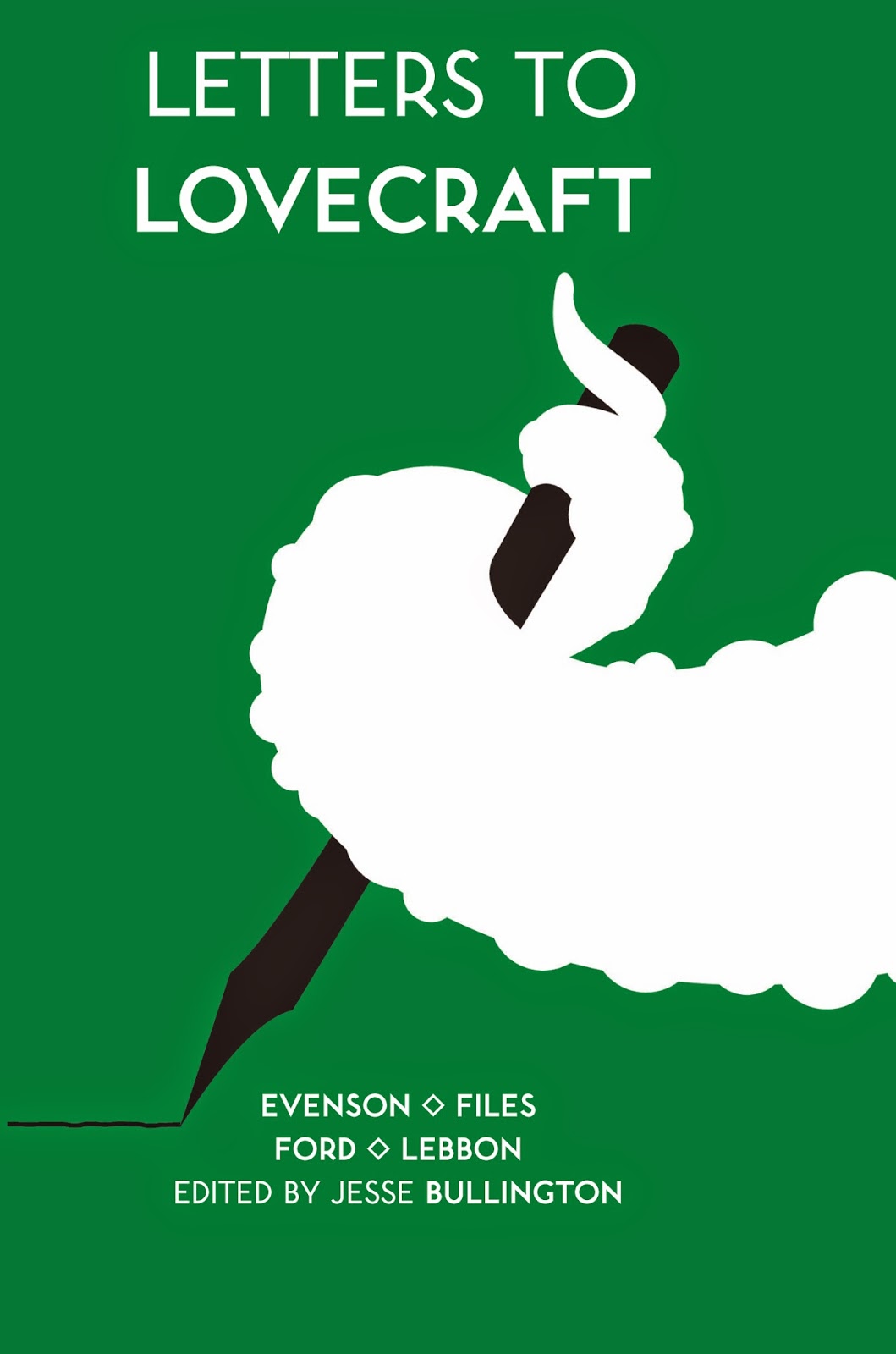
Reviewish: Letters to Lovecraft
The end of 2014 was a bit of a personal mess, full of head-colds and surgical biopsies and final papers. The start of 2015 hasn't been nearly as bad, but it has been just as busy (how is it already late March?). Those excuses, however, do not absolve me of the guilt I contain over this review - which was owed to the general public back in November. It was meant to be one of my 'fire' updates in December, but got lost in the mix.
So, with great shame, I finally bring you my review of:
Letters to Lovecraft
edited by Jesse Bullington
Stoneskin Press
Up front, I must say Lovecraft's "Supernatural Horror in Literature" has been a touchstone for me in academic papers and in conversations about the importance and impact of horror literature for many years. Therefore, it should come as no surprise that I was exceedingly excited to get my hands on an Advance Review Copy of this collection. (I pursued it before I came down with what would be a 4 week viral ordeal, with ripple effects I'm still feeling more than 4 months later.)
I cannot say it half so well as Publishers Weekly or SFF World -- but I agree wholeheartedly with them that this collection is something different in the best of ways.
Each author selects a particular passage from Lovecraft's essay and introduces their story with a brief explanation of their relationship with that passage. This made the collection all the more enticing for me, as a reader and student of academia. It is often a valuable insight to hear the author's own voice when engaging with works that are part of a conversation, such as the conversation created between these tales and Lovecraft's essay.
The format also creates a binding thread that runs through the anthology, making every story fit. There isn't a slacker or outlier in the bunch. I was hypnotized and drawn into each story through not only the writer's craft, but the interaction between Lovecraft's essay and the author's view of it.
This anthology is the sweet spot between academic engagement and idolic entertainment.
Of the entire collection, many stories stuck with me; to pick a favorite would be an impossible task. Would I choose Grey's dabbling in using Lovecraft as a character, Jones' lycanthropic romp, or Files' exploration of things hidden in childhood? (I could honestly list EVERY author's name here and give a reason for their story to be a favorite...) But, at the end of the day, one story has stayed with me over the months - even though I've skipped it on re-reads of the collection because it creeped me out so much - and that is Nadia Bulkin's "Only Unity Saves the Damned".
No spoilers here, but if you give it a read and at first think "Oh, just another kids with a video camera horror story," think again and keep reading - that is only the frame for something much, much creepier.
If you're curious but not yet certain about getting this collection for yourself, Stoneskin Press did a series of "Teasers to Lovecraft" that will give you a taste of what the collection has to offer, including the introduction I mention above to Nadia's deliciously unsettling tale.
So, with great shame, I finally bring you my review of:
Letters to Lovecraft
edited by Jesse Bullington
Stoneskin Press
" ‘The oldest and strongest emotion of mankind is fear, and the oldest and strongest kind of fear is fear of the unknown.’
So begins H. P. Lovecraft’s essay “Supernatural Horror in Literature,” arguably the most important analysis of horror ever written. Yet while hordes of writers have created works based on Lovecraft’s fiction, never before has an anthology taken its inspiration directly from the literary manifesto behind his entire mythos…until now.
Like cultists poring over a forbidden tome, 18 modern masters of horror have gathered to engage with Lovecraft’s famous essay, 'Supernatural Horror in Literature'. Rather than responding with articles of their own, these authors have written new short stories inspired by Lovecraft's treatise, offering their own whispers to the darkness. They tell of monsters and madmen, of our strange past and our weirder future, of terrors stalking the winter woods, the broiling desert, and eeriest of all, our bustling cities, our family homes."
(from Stoneskin Press)
Up front, I must say Lovecraft's "Supernatural Horror in Literature" has been a touchstone for me in academic papers and in conversations about the importance and impact of horror literature for many years. Therefore, it should come as no surprise that I was exceedingly excited to get my hands on an Advance Review Copy of this collection. (I pursued it before I came down with what would be a 4 week viral ordeal, with ripple effects I'm still feeling more than 4 months later.)
I cannot say it half so well as Publishers Weekly or SFF World -- but I agree wholeheartedly with them that this collection is something different in the best of ways.
Each author selects a particular passage from Lovecraft's essay and introduces their story with a brief explanation of their relationship with that passage. This made the collection all the more enticing for me, as a reader and student of academia. It is often a valuable insight to hear the author's own voice when engaging with works that are part of a conversation, such as the conversation created between these tales and Lovecraft's essay.
The format also creates a binding thread that runs through the anthology, making every story fit. There isn't a slacker or outlier in the bunch. I was hypnotized and drawn into each story through not only the writer's craft, but the interaction between Lovecraft's essay and the author's view of it.
This anthology is the sweet spot between academic engagement and idolic entertainment.
Of the entire collection, many stories stuck with me; to pick a favorite would be an impossible task. Would I choose Grey's dabbling in using Lovecraft as a character, Jones' lycanthropic romp, or Files' exploration of things hidden in childhood? (I could honestly list EVERY author's name here and give a reason for their story to be a favorite...) But, at the end of the day, one story has stayed with me over the months - even though I've skipped it on re-reads of the collection because it creeped me out so much - and that is Nadia Bulkin's "Only Unity Saves the Damned".
No spoilers here, but if you give it a read and at first think "Oh, just another kids with a video camera horror story," think again and keep reading - that is only the frame for something much, much creepier.
If you're curious but not yet certain about getting this collection for yourself, Stoneskin Press did a series of "Teasers to Lovecraft" that will give you a taste of what the collection has to offer, including the introduction I mention above to Nadia's deliciously unsettling tale.
Wednesday, December 24, 2014
Reviewish: The Running of the Tyrannosaurs
I rarely pre-order books. This isn't because I don't love books or value authors (on the contrary, authors are my rockstars and I could build a queen-sized bed out of the books I own in physical copy) - this is because my to-read list is so long and I often don't get to a book fast enough to warrant the pre-order option. (And there's the matter of affording books better when they are on sale.)
That said, I pre-ordered Stant Litore's The Running of the Tyrannosaurs. The morning it became available, I read it. You could say I devoured it - but I don't want to get even that close to making a dinosaur pun.
Like his previous works (The Zombie Bible and The Ansible Stories), Litore embraces some well-known fiction fodder that might be looked on as too cliche, and turns it into something truly great and worthy of deeper consideration.
Egret is a girl and athlete; she has been selected, altered by nanotechnology, and is a sacrifice for the people. She's an icon, a symbol, and she has been groomed to know and embrace that fact. The story is from her point of view, told in her self-assured voice, and relates the most important day of her life - Patriot Day. This is a day when Egret, and girls like her - embodiments of Liberty - will run with the scientifically resurrected tyrannosaurs for a spectacle.
It's easy to pull out some modern commentary from this story (the girls are rebuilt by their nanites to be 'perfect'), but it's the deeper layer that I found so engaging. Egret, all the runners on Patriot Day, are in competition with each other. This competitive spirit drives Egret, but as she moves through her day, as we get to view her thoughts so directly, there's something else going on. Something that not even Egret completely understands.
It's difficult to discuss it too much without giving spoilers.
It's the dawning of consciousness of a different sort that makes Egret an engaging voice and a perfect narrator for this story. Though it is internal and entirely a sort of stream-of-consciousness journey, Egret is extremely present in her experience. Her thoughts, like the events of Patriot Day, move at a brisk pace and never get bogged down.
The story is succinct, with just enough embellishment (in the form of a little back-story on our narrator) to make it a whole. As always, Litore's execution is spot-on. The story is cohesive and pulls the reader into the moment with Egret. Egret's voice is unique amongst the ever-growing pantheon of Litore's characters and brings the story a gritty, hot texture. The world building is just enough to situate you for the story, but leaves you intrigued to learn more. And - if rumors (from the author!) are true, readers will get a chance to get to know the world of this story more in a future novel.
If it's half as good as this installment (and I'm willing to wager it'll be twice as good), I'm looking forward to it.
Oh, better not forget the fire. Is this working for you? Heating things up? No, better leave the puns out of it. So concludes the second Fire Episode of Reviewish.
![]() |
| Can we marvel, for a moment, at Roberto Calas' cover? |
Like his previous works (The Zombie Bible and The Ansible Stories), Litore embraces some well-known fiction fodder that might be looked on as too cliche, and turns it into something truly great and worthy of deeper consideration.
Egret is a girl and athlete; she has been selected, altered by nanotechnology, and is a sacrifice for the people. She's an icon, a symbol, and she has been groomed to know and embrace that fact. The story is from her point of view, told in her self-assured voice, and relates the most important day of her life - Patriot Day. This is a day when Egret, and girls like her - embodiments of Liberty - will run with the scientifically resurrected tyrannosaurs for a spectacle.
It's easy to pull out some modern commentary from this story (the girls are rebuilt by their nanites to be 'perfect'), but it's the deeper layer that I found so engaging. Egret, all the runners on Patriot Day, are in competition with each other. This competitive spirit drives Egret, but as she moves through her day, as we get to view her thoughts so directly, there's something else going on. Something that not even Egret completely understands.
It's difficult to discuss it too much without giving spoilers.
It's the dawning of consciousness of a different sort that makes Egret an engaging voice and a perfect narrator for this story. Though it is internal and entirely a sort of stream-of-consciousness journey, Egret is extremely present in her experience. Her thoughts, like the events of Patriot Day, move at a brisk pace and never get bogged down.
The story is succinct, with just enough embellishment (in the form of a little back-story on our narrator) to make it a whole. As always, Litore's execution is spot-on. The story is cohesive and pulls the reader into the moment with Egret. Egret's voice is unique amongst the ever-growing pantheon of Litore's characters and brings the story a gritty, hot texture. The world building is just enough to situate you for the story, but leaves you intrigued to learn more. And - if rumors (from the author!) are true, readers will get a chance to get to know the world of this story more in a future novel.
If it's half as good as this installment (and I'm willing to wager it'll be twice as good), I'm looking forward to it.
Oh, better not forget the fire. Is this working for you? Heating things up? No, better leave the puns out of it. So concludes the second Fire Episode of Reviewish.
Friday, December 19, 2014
Reviewish: Ansible 15717
Today is a Fire Episode of Reviewish. I've been a little overwhelmed with health, school, and general life stuff - as a result, I'm behind the eight ball, as it were. (Is that the right expression? What does that mean? I always pictured it as a moment similar to when Indiana Jones is threatened with imminent crushing by the boulder trap.) In that sense, I'll be posting up several reviews in quicker succession than I have previously.
Fire Review #1: Ansible 15717, Book Three of the Ansible Stories from Stant Litore.
As ever, Stant Litore's prose is a delight to read. Ansible 15717 (the character flung across space (and maybe time)), instead of being an Ansible seemingly assigned to a random world, is a woman courted by Starmind, targetted for a world they know at least something about. It's disturbing to consider that Ansible 15715 and 15716 might've been purposefully selected for the worlds to which they were sent, now that I think about it...
In that sense, it is a relief - one unsought, one I didn't even realize I might have wanted - to have a narrator with a slightly higher level of control than the first two Ansibles. She is a woman deeply tied to her botany, well equipped (as well as one can be) to become part of a plant-based species and world.
Litore finds and walks that sweet spot between science-fiction and fantasy, perhaps reminding me of one reason those two genres are situated together so often. The inhabitants of this new planet, his description of them and their world, painted lush pictures in my mind while I read. If I were any good at art, this review would be peppered with delicate drawings of humanoid-like (but not quite) plants, lush jungle settings, colorful and dangerous flora of all sorts.
This is a story that builds itself in the mind's eye and gently enfolds you in its leafy embrace.
Between flashbacks and her experiences on this new world, there is a wonderful balance of the delicate and the willful, strength and weakness, pain and love. She never becomes immune to her humanity, even while embracing her new alien life and body.
All the aspects of this particular work that might be pulled out and highlighted as progressive/inclusive/intersectional (or, if you don't enjoy that sort of thing, "PC") are melded seamlessly into the story. Is it a big deal that the narrator is, as one reviewer on Amazon summarized, an "agnostic lesbian Muslim scientist"? In ways, it is. There is a lot of meat to consider here about representation and much deeper societal issues - But in the course of telling the story, Litore makes them simply part of the story - it never comes across that he's inserted these things with an agenda, they are never over-emphasized.
The true beauty of this diversity lies in the fact that it makes the Ansible's story the story of another human being - whole and perfect, even in her flaws. Every aspect is part of the weave of the fabric, not an embellishment or an afterthought applique - they belong there from the beginning. This, for me, is an ideal way of storytelling, of integrating all the beautiful variety of humanity.
In short; Ansible 15717 is another solidly written short story and brings a new world of beauty and terror to the Ansible Stories. Stant Litore has set the bar high for himself, his work, and he's continued to deliver. If you've ever enjoyed any of his work, I highly recommend this (and all of the Ansible stories, if you haven't read any of them specifically). If you've never read anything by Stant Litore, the Ansible Stories are a great way to start.
Though they are not directly related, and I believe you CAN read the Ansibles in any order, I might recommend picking them up in order anyway. It is difficult for me to judge, having read them in order and being unable to unknow what I know to make the comparison, but each story builds in a little tidbit of information about the mysterious Starmind and what the Ansibles are about. That said, you are probably just fine reading them in any order (just like The Zombie Bible!).
Oh, right, I promised fire:
Monday, October 20, 2014
Reviewish: Love & Other Poisons - Silvia Moreno-Garcia
I don't know why I waited so long to read work by Silvia Moreno-Garcia. Honestly and truly. There wasn't any particular reason I put it off - I've know about her through Lovecraftian community associations for a while. I've followed/associated with her on Facebook since the Ladies & Squids conversation in a FB group spawned the clarion call for ladies writing in weird fiction to get a spotlight shone on them.
In fact, I'm exceedingly excited about the project that came out of that discussion: She Walks In Shadows - An all-woman Lovecraft anthology - the first, even. (I couldn't decide which link to use, so I thought I'd use the four most prominent/important links that will provide information on the project.)
Since then, I've dragged my feet in seeking out and devouring new fiction. My Reviewish posts represent a long-running backlog of reading - though not the only reading I'm doing (never mind the academia stuff) - that really got me excited about authors who were new-to-me. Silvia gets added to this list.
Sometimes I feel ashamed in going for offers of free books for reviews, but it's really the only way I can 'afford' to explore new authors. I'm a college student with 3 very flimsy and irregular part time jobs. My food budget for 1-2 weeks is what most people spend on a cheap dinner out. So, when Silvia posted that she was willing to give out a copy of her short story collection Love & Other Poisons in exchange for a review, I was more than happy to oblige.
I didn't know what to expect, but I was looking forward to the discovery of it all. I was not disappointed.
I will start by saying that the book itself - I read the electronic format - is well done. The cover art is lovely, and I only found a couple of places where there may or may not have been minor typos (they were so minor that I only remember they existed, not where they were. I should go back and make notes and forward those back to the author/publisher in case they want to fix them).
I read the collection on the bus and was so enthralled with it that a complete stranger tapped me on the shoulder to ask what I was reading. This has never happened to me before. It's true, though, I was enthralled.
Right out of the gate, the stories don't fall into too-familiar archetypes. They don't all follow the expectations we get for short stories from our mountains of literature or creative writing courses. What do they do? They weave a moment of time, a series of events, into a mural that stands out and stands up against the mundanity in which they exist. (Though I'd argue that some of the worlds the author presents through these stories are anything but mundane, even if you are steeped in fantastical literature.)
One theme that spoke strongly to me and I thus saw repeated was that of escaping with a "magical" companion. Don't read 'magical' literally - though you could. (That's a part of the allure of the collection on the whole - the promise and lure that something could be taken as so much more than it is, or that you can take at face value.)
My favorites:
"Man in Blue Overcoat"
"Shedding Her Own Skin"
"Distant Deeps or Skies"
"A Puddle of Blood"
These four stories interestingly contain an equal balance of staying and leaving, and being tempted away from one's regular life. But it's not quite temptation; in at least a couple cases, it is an opportunity for escape.
I wonder if Theresa ever accepts the offer of the nahual.
Honorable Mentions:
"Kaleidoscope" - the theme here is other lives. This story resounded with me as this is a scenario I've conjured in my mind in relation to particular people in my life. If it's nothing you've experienced, you might not connect the same way to the story.
"Enchantment" - oddly enough, this is the story I was reading when the stranger on the bus interrupted me. It's about self-narratives and the people around us who might choose to play the roles we've assigned them, and what happens when we ruin our own stories by pushing too hard, lingering too long in a moment.
"A Handful of Earth" - can't knock a callback to Dracula and what happens to his 'brides' when he's gone away. It's a look into the evolution of a vampire, and what that story might look like from the inside.
I could go on and on about almost every story in the collection. There's nothing bad for me to say about any of them. Some I obviously liked more than others, but I didn't dislike any of them. I didn't find any of them particularly "weak" and none of them felt like filler. Though my experience is admittedly sparse when it comes to single-author short story collections, this one stands as a very solid example. It is likely to be the standard against which I judge other single-author collections going forward.
Many of these stories crafted worlds I wanted to explore beyond their boundaries. That is the beauty of a well wrought short piece; being able to tell a story in the context of a whole other world that makes sense, and to make it feel as though there is a whole wide, fleshed-out world behind it. It leaves you wanting more but not unsatisfied. Silvia Moreno-Garcia nails it.
I'm looking forward to picking up more of her work.
Wednesday, August 6, 2014
Reviewish: I Will Hold My Death Close
These are much more full-reviews than just... 'reviewish'. At first, the "Reviewish" title came into being because I didn't intend to do reviews of films or books or anything else. However, giving my own views on a film got this started and the name seems to work. I don't consider myself a professional reviewer or even an expert one - or any other authority-implying descriptions. I just know what I like or don't and why in each case. I like sharing.
Continuing in that vein, I was given an advanced review copy of Stant Litore's newest installation in the Zombie Bible stories, I Will Hold My Death Close (available for pre-order, releases August 26th).
In short: I loved it. It didn't get to me quite as strongly as No Lasting Burial, but that text had a lot more time to build up and grow on me. In the short time available to the narrator in I Will Hold My Death Close still grabs a reader tightly and doesn't let go. She is just as unique and powerful as the narrators in the author's Ansible stories.
I pretty well summed up my feelings in my Amazon review, reproduced here for ease of reading:
Continuing in that vein, I was given an advanced review copy of Stant Litore's newest installation in the Zombie Bible stories, I Will Hold My Death Close (available for pre-order, releases August 26th).
In short: I loved it. It didn't get to me quite as strongly as No Lasting Burial, but that text had a lot more time to build up and grow on me. In the short time available to the narrator in I Will Hold My Death Close still grabs a reader tightly and doesn't let go. She is just as unique and powerful as the narrators in the author's Ansible stories.I pretty well summed up my feelings in my Amazon review, reproduced here for ease of reading:
Another snapshot from the world of The Zombie Bible. Confronted by death - both figurative and literal - the heroine of the story has to learn to face it, to take her death (and her life - what remains of it) and make it her own. In a world where her destiny seems to be entirely out of her hands, her death is one thing she refuses to give into someone else's control.
"I Will Hold My Death Close" is a beautiful and heart-wrenching narrative; it grabs you by the collar and doesn't let you look away. The narrator's voice is eloquent and earnest. This is, perhaps, the most striking part of Litore's storytelling; he has yet to disappoint me in the voices he harnesses to tell his tales. Like the Ansible stories, this character is her own and creates a portrait of a unique person, in her own set of circumstances, with her own particular point of view.
Solid writing & characterization with the personality I've come to expect of the Zombie Bible stories, I wouldn't hesitate to recommend this to any reader who's enjoyed Litore's work before. I'd also comfortably suggest it to someone curious about the series - it's short and gives a pretty good impression of what one can expect in the rest of the series (which is in no particular order).
If I had anything to complain about, it would be the length - but not for any good reason, I just wanted more! It's a quick read, but the narrative is whole & complete; it didn't need "more" telling to bulk it out.Not part of my review, I want to add that the ending particularly engaged me. A sort of epilogue, it was the perfect way to wrap up, inscribe, and carry on the narrative of Yeptha's daugther. If a story is a fine meal, this ending was the perfect bite on which to end it.
Wednesday, June 25, 2014
Reviewish: Ansible 15715 & Ansible 15716
"Ansible
15715" & "Ansible 15716", Stant Litore
*This has made me want to talk about the concept of ansibles, but I will save that for another time.
I will strive to be spoiler free.
Up front, I want to say that I wish I’d thought of this first. The Ansible Stories seem like the perfect depository/showcase for all the alien worlds that exist in our imaginations; places that have a story that (I feel I) would ruin the mystique to tell.
Each tale leaves you wanting more, but not with the feeling of missing something. Like an amuse-bouche, they are single bites and give you a taste of what the mind of the author might have to offer you.
As always, Stant Litore’s prose just fits. It’s not the same lyrical language from No Lasting Burial, but that is by necessity. Each piece is from the perspective of a different ‘Ansible’ and they are very individual characters. The language used feels like the language of someone talking to you (and they are talking to you) without lapsing into the mode of ‘bad monologuing’. Something I always wonder when I pick up reading a ‘new’ author (can I count my experience with Mr. Litore as ‘new’ anymore? probably not) is whether their writing quality is consistent across projects. It is my opinion that Litore’s work maintains its quality without being monotonous within itself.
There are some themes echoed between them, but they are not identical tales dressed in different clothes. Both deal with ideas of isolation and alienation and loss (facets of a different, whole nameless thing), but both do so in a slightly canted way from one another.
In a way, I would enjoy this as a ‘shared world’ style of stories because these tales ignite in me a desire to play in writing again, in the Ansible cosmos. I cannot fathom that I'm alone in this thought. I hope this is considered as much of a compliment as I feel it to be.
Both of these stories have lingered with me since I read them. In a moment of complete dissociation, I came back from daydreaming feeling very, very odd - and my mind immediately related it to how the Ansibles must’ve felt in these stories. If the contents of 15715’s transmission didn’t reach to the secret corners of terror in my soul, that moment and thought certainly did.
I imagine an entire collection of these stories - and I imagine using those stories the way a tabletop gamer might use the Manual of Planes or Beyond Countless Doorways for new destinations reached in unconventional ways. I very much hope that these stories continue (there is a promise for 15717).
For the
sake of review sites, I have to talk about the stories individually, but my
mind already considers them a singular unit. I’m including these singular
breakdowns here.
Ansible 15715 - All the Lovecraft Flavor, without the Antiquarian Verbiage!The reviews that mention the Lovecraftian flare of this piece are spot-on. This is Weird Fiction without the Pulp aesthetic and it works very well. (I’m a fan of the aesthetic of Pulp era fictions, but love & appreciate when some of the ‘weirder’ parts of its spirit works into more contemporary pieces.)
It is a
quick read, and the character’s voice is consistent to the characterization. I
did not experience any "fridge moments" and the only question I had
at any point in the story had everything to do with knowing something that I
couldn’t know because the character couldn’t know it. (Oh, first person
stories, our torrid romance continues!)
Per the
reviews of other readers, I imagine this story will be fairly unsettling - for
me, it was pretty delightful. My tastes already lie firmly in Lovecraftian
territory. And my mind often wanders in pretty lonely and isolated modes.
Ansible 15716 - Leaves One Wanting - to hear from more AnsiblesAs I said of Ansible 15715, this piece is a quick and smooth read with a voice consistent with the characterization.
It was difficult to read this as a ‘regular’ reader; I had several inclinations while reading it to do so as a college Lit major. Take that as you will, though to me it is pretty high praise. It is Science Fiction and it is on the borders of what some might label “Weird”, but it is also deeply felt in the way that so much of Litore’s work manages to be. It speaks with a voice worthy of closer inspection and introspection – everything literature can & should aspire toward.
Without getting into spoilers, this Ansible tale is gentler in some ways and harsher in others than the one preceding it. It sacrifices none of Litore’s skill at weaving together a good story and the right kind of cadence for the telling.
Whenever I
try to find words to capture the emotions elicited by this story, I find myself
at a lack – or perhaps simply unable to communicate them adequately through the
means available. Apropos, given the story about which I’m speaking.
Hauntingly beautiful story.
Subscribe to:
Posts (Atom)